
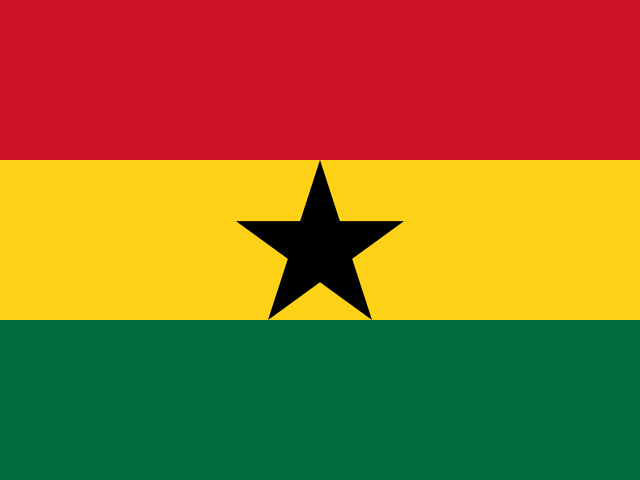
 Ghana
Ghana



Ghana: The Black Star of West African Democracy
Ghana is the country of Kwame Nkrumah, father of Pan-Africanism, the first sub-Saharan African country to gain independence in 1957. This historic pride still runs through Ghanaian society: Ghana sees itself as a beacon, a model, a Black Star guiding the continent. And it has earned the right: since 1992, the country has seen four peaceful transitions of power, making it one of Africa's most consolidated democracies.
The Ghanaian Democratic Model
Ghana has proved that political alternation is possible in West Africa. In 2000, 2008, 2016 and 2024, the ruling party lost elections and peacefully handed over power. The press is free, civil society is vibrant, institutions work. This is no miracle: it is the result of patient institutional building, a balanced constitution, and a political culture that values debate.
The Ubuntu Strength: Hospitality and Coexistence
Ghana is famous for its hospitality. The expression "Akwaaba" (welcome in Akan) is not an empty phrase: it reflects a deep disposition towards welcoming others. The country has around a hundred ethnic groups — Akan, Ewe, Ga, Dagomba — who coexist without civil war. Traditional chiefs still play an important mediation role. The Ghanaian diaspora, particularly in the United States and the United Kingdom, maintains strong ties with the country.
« Obi nkyere akwadaa Nyame »
Nobody needs to teach a child who God is
— Proverb akan
Ghana reminds us that Pan-Africanism is not just an ideology — it is a daily practice of solidarity, hospitality and shared pride. As Nkrumah said: Africa must unite or perish. Ghana has chosen to live — and to lead the way.